B-20, West Patel Nagar, New Delhi-18 (India) | 011-39330001 |
  +91-762-691-24-36 | Email: info@peoplemanager.co.in


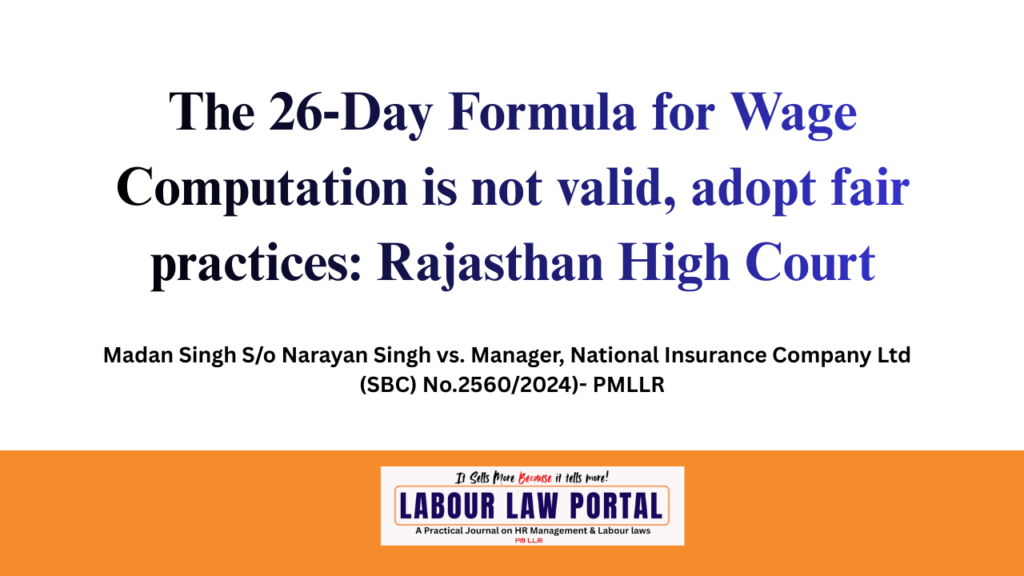
In a significant ruling that could reshape wage calculation practices across India, the Rajasthan High Court has struck down the long-standing 26‑day wage formula used for daily‑wage workers. The Court held that the formula is unrealistic and unfair, given the economic realities faced by daily labourers, and directed both Union and State labour departments to amend wage notifications to reflect a 30‑day month basis instead.
This judgment not only enhances compensation in accident claim cases but also signals a broader shift in how courts and policymakers view the rights of unorganised and daily‑wage workers.
The Case
The case arose from an appeal against a Motor Accident Claims Tribunal (MACT) award. The appellant, a daily‑wage worker, had suffered a 13% permanent disability in a motorcycle accident. The tribunal had calculated compensation using the 26‑day wage formula, which assumes one weekly off and computes monthly wages accordingly. This reduced the worker’s assessed income and, consequently, the compensation amount.
The appellant challenged this calculation before the High Court, arguing that the formula did not reflect the ground realities of daily‑wage employment, where workers often have to work all seven days of the week to meet basic subsistence needs.
Court’s Observations
Justice Anoop Kumar Dhand made several critical observations:
- Unrealistic Assumption of Weekly Offs: The Court noted that while labour laws mandate at least one weekly rest day, daily‑wage workers typically do not receive paid leave for these offs. In practice, many work all seven days to survive. Assuming only 26 working days per month unfairly reduces their actual earnings.
- Economic Vulnerability of Daily Wagers: The Court emphasised that daily‑wage workers are among the most economically vulnerable sections of society. Any formula that artificially lowers their income calculations directly impacts their compensation and financial protection.
- Need for Policy Correction: The Court held that the 26‑day formula is outdated and unjust. It directed the Union and State labour departments to revise wage calculation norms to reflect a 30‑day month basis, ensuring that wage assessments align with the realities of daily‑wage employment.
The Judgment
The High Court partially allowed the appeal, enhancing the compensation amount by approximately ₹33,000, with interest at 6% per annum. While leaving the rest of the MACT’s decision unchanged, the Court categorically rejected the 26‑day formula and ordered that minimum wages be calculated on a 30‑day basis.
Further, the Court directed that copies of the judgment be forwarded to the relevant departments within both the Union and Rajasthan labour ministries. This step ensures that appropriate amendments to minimum wage notifications and circulars can be made, preventing similar injustices in future cases.
Legal Significance
This judgment carries wide‑ranging implications:
- Correction of Wage Norms: By rejecting the 26‑day formula, the Court has paved the way for a more realistic wage calculation system. This could influence not only accident compensation cases but also broader wage assessments under labour laws.
- Judicial Recognition of Ground Realities: The ruling reflects the judiciary’s growing sensitivity to the economic vulnerabilities of unorganised workers. It acknowledges that statutory provisions must be interpreted in light of practical realities.
- Directive to Government: The Court’s order to amend wage notifications places responsibility on both Union and State labour departments to ensure that wage policies are fair and aligned with workers’ needs.
Broader Implications
For Workers
- Daily‑wage workers stand to benefit from higher wage calculations, which will directly impact compensation in accident claims and other wage‑linked benefits.
- The ruling provides judicial recognition of their struggles, reinforcing their right to fair wages.
For Employers
- Employers may need to adjust wage structures to reflect a 30‑day month basis.
- This could increase labour costs, but it also ensures compliance with constitutional principles of fairness and equity.
For Labour Law
- The judgment sets a precedent for revisiting outdated wage calculation norms.
- It may influence future cases across India, prompting other High Courts to adopt similar reasoning.
Constitutional and Policy Context
Labour laws in India mandate weekly rest days, but the reality for daily‑wage workers is starkly different. Most do not receive paid leave and must work continuously to survive. By rejecting the 26‑day formula, the Rajasthan High Court has aligned wage calculation with constitutional principles of fairness and social justice.
The directive to amend government notifications underscores the need for policy reforms that reflect the lived experiences of workers, rather than abstract statutory assumptions.
Practical Takeaways
Wage Calculation Must Reflect 30 Days: Courts and tribunals should calculate minimum wages on a 30‑day basis for daily‑wage workers.
Compensation Awards Will Increase: Accident claim compensation and other wage‑linked benefits will rise, providing greater financial protection to workers.
- Policy Amendments Required: Labour departments must revise notifications and circulars to ensure compliance with the Court’s directive.
- Employers Must Adapt: Organisations employing daily‑wage workers must align their wage practices with the new standard.
Conclusion
The Rajasthan High Court’s ruling rejecting the 26‑day wage formula marks a turning point in labour law jurisprudence. By recognising the harsh realities faced by daily‑wage workers and directing the government to amend wage rules, the Court has reinforced the principle that labour law must serve the cause of social justice.
This judgment is not merely about numbers; it is about dignity, fairness, and the right of workers to be compensated in line with their actual labour. As India continues to grapple with issues of informal employment and economic vulnerability, the ruling serves as a reminder that the judiciary can play a vital role in bridging the gap between statutory provisions and lived realities.