B-20, West Patel Nagar, New Delhi-18 (India) | 011-39330001 |
  +91-762-691-24-36 | Email: info@peoplemanager.co.in


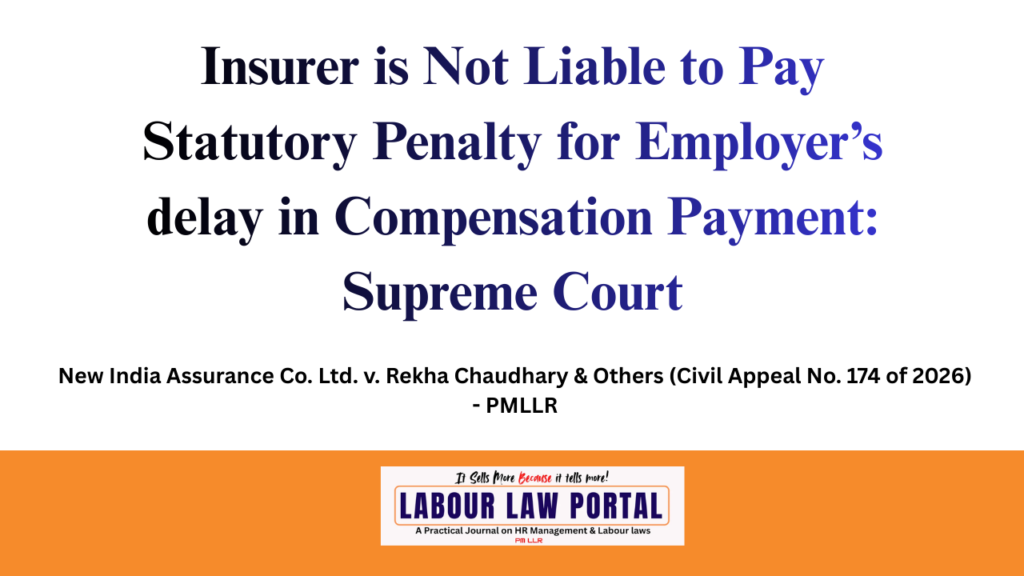
The Supreme Court’s decision in New India Assurance Co. Ltd. v. Rekha Chaudhary & Others (Civil Appeal No. 174 of 2026) marks a significant reaffirmation of the jurisprudence surrounding employer liability under the Employees’ Compensation Act, 1923 (EC Act). The ruling clarifies the boundaries of insurer responsibility, particularly in relation to statutory penalties imposed for delayed compensation payments. This judgment not only settles the immediate dispute but also provides interpretative guidance for the transition to the Social Security Code, 2020 (SSC), which consolidates and modernizes labour welfare legislation.
The Case
The case arose from the death of a driver during the course of employment. His legal heirs filed a claim under the EC Act. The Labour Commissioner awarded ₹7,36,680 in compensation, along with 12% interest, and imposed a 35% penalty on the employer for failing to deposit the compensation within the statutory one‑month period mandated by Section 4A.
The employer’s vehicle was insured with New India Assurance Co. Ltd. On appeal, the Delhi High Court extended liability for not only compensation and interest but also the penalty to the insurer. The insurer contested this extension, leading to the Supreme Court’s intervention.
Legal Issues
The central question before the Court was:
- Whether an insurer can be held liable for the statutory penalty imposed on an employer under Section 4A(3)(b) of the EC Act for delayed payment of compensation.
Supreme Court’s Reasoning
1. Distinction between Compensation, Interest, and Penalty
The Court emphasized the tripartite structure of liability under Section 4A:
- Compensation: A statutory obligation arising directly from the accident and payable to the dependents.
- Interest: A compensatory measure to account for delay in payment, indemnifiable by the insurer.
- Penalty: A punitive sanction imposed for unjustified default, reflecting personal fault of the employer.
The Court held that while compensation and interest are indemnifiable risks under an insurance policy, the penalty is a statutory punishment for employer misconduct and cannot be transferred to the insurer.
2. Precedent Reliance
The Court traced its reasoning to earlier rulings:
- Ved Prakash Garg v. Premi Devi (1997): Established that insurers are liable for compensation and interest but not for penalties.
- Sheela Devi v. Oriental Insurance Co. Ltd. (2019): Reaffirmed the principle that penalties are personal liabilities of employers.
By invoking these precedents, the Court reinforced continuity in judicial interpretation.
3. Nature of Penalty under Section 4A(3)(b)
The Court clarified that the penalty is not compensatory but deterrent. It is designed to discipline employers and ensure timely compliance. Allowing insurers to bear this burden would dilute the deterrent effect, as employers could evade responsibility by shifting liability to insurers.
The Judgment
The Supreme Court allowed the appeal in part:
- Insurer Liability: Confirmed for compensation and interest.
- Employer Liability: Solely responsible for penalty. Directed to deposit the penalty within eight weeks.
This outcome reinstates the principle that penalties under labour welfare statutes are non‑transferable and must be borne by the defaulting employer.
Implications for Labour Law and Social Security
Reinforcement of Employer Accountability: The ruling underscores that statutory penalties are instruments of accountability. Employers cannot rely on insurance contracts to shield themselves from punitive consequences of non‑compliance.
Insurance Contract Interpretation: The judgment clarifies that insurance policies cover indemnifiable risks but not punitive sanctions. This distinction is crucial for drafting and interpreting insurance contracts in the labour law context.
- Transition to Social Security Code, 2020 : The SSC consolidates provisions of the EC Act. Relevant sections include:
- Section 77(2): Provides for “damages” (penalty) for default in payment of compensation.
- Section 133: Specifies penalties for failure to pay contributions, including fines and imprisonment.
- 30‑Day Notice Requirement: Employers must be given notice before penal action, reinforcing procedural fairness.
The Supreme Court’s interpretation of Section 4A(3)(b) will guide application of these provisions under the SSC. The principle remains: penalties are personal liabilities of employers.
Comparative Analysis: EC Act vs. SSC
Aspect | Employees’ Compensation Act, 1923 | Social Security Code, 2020 |
Compensation | Section 4 | Section 76 |
Interest | Section 4A(3)(a) | Section 77(1) |
Penalty | Section 4A(3)(b) (up to 50%) | Section 77(2) (damages for default) |
Enforcement | Commissioner imposes penalty | Inspector‑cum‑Facilitator issues 30‑day notice before penal action |
Employer Liability | Personal for penalty | Personal for damages and contributions |
This comparison shows continuity in principle but modernization in procedure under the SSC.
Policy Rationale
The Court’s ruling aligns with broader policy objectives:
- Deterrence: Ensures employers comply with statutory timelines.
- Social Security Integrity: Protects dependents of employees by guaranteeing timely compensation.
- Insurance Balance: Prevents insurers from being unfairly burdened with punitive liabilities beyond contractual scope.
Judgement Criticallity
Strengths of the Judgment
- Consistency with Precedent: Upholds established jurisprudence.
- Clarity in Liability Allocation: Distinguishes between compensatory and punitive obligations.
- Alignment with SSC: Provides interpretative guidance for future application.
Potential Concerns
- Employer Evasion: Some employers may still attempt to delay payments, knowing penalties are personal but often difficult to enforce.
- Dependents’ Burden: Dependents may face hardship if employers default on penalty payments, as insurers are not liable.
Suggested Reforms
- Stronger Enforcement Mechanisms: SSC’s 30‑day notice is a step forward, but stricter enforcement may be needed.
- Public Disclosure of Defaults: Naming defaulting employers could enhance deterrence.
- Integration with Wage Payment Systems: Linking compensation payments to digital wage platforms could reduce delays.
Practical Guidance for Employers and Insurers
Employers
- Must treat compensation payments as immediate statutory obligations.
- Cannot rely on insurance to cover penalties; must budget for potential liabilities.
- Should establish compliance monitoring systems to avoid defaults.
Insurers
- Should clarify policy terms to exclude penalties explicitly.
- Must prepare to indemnify compensation and interest promptly.
- Should educate employers about the limits of insurance coverage.
Broader Labour Law Context
The ruling reflects a broader judicial trend of reinforcing employer accountability in labour welfare statutes. Similar principles apply under:
- Payment of Gratuity Act, 1972: Delays attract interest, but penalties remain employer’s liability.
- Employees’ Provident Funds Act, 1952: Damages for default are employer’s responsibility, not transferable to insurers.
Thus, the judgment harmonizes with the overall architecture of labour law enforcement in India.
Conclusion
The Supreme Court’s ruling in New India Assurance Co. Ltd. v. Rekha Chaudhary & Others is a landmark reaffirmation of employer liability under the Employees’ Compensation Act. By distinguishing between compensatory obligations (indemnifiable by insurers) and punitive sanctions (personal to employers), the Court has preserved the deterrent function of statutory penalties. This principle will continue to guide interpretation under the Social Security Code, 2020.
The judgment strengthens the accountability framework in labour law, ensuring that employers remain directly responsible for compliance. It also provides clarity for insurers, employees, and dependents, thereby enhancing the integrity of India’s social security system.