B-20, West Patel Nagar, New Delhi-18 (India) | 011-39330001 |
  +91-762-691-24-36 | Email: info@peoplemanager.co.in


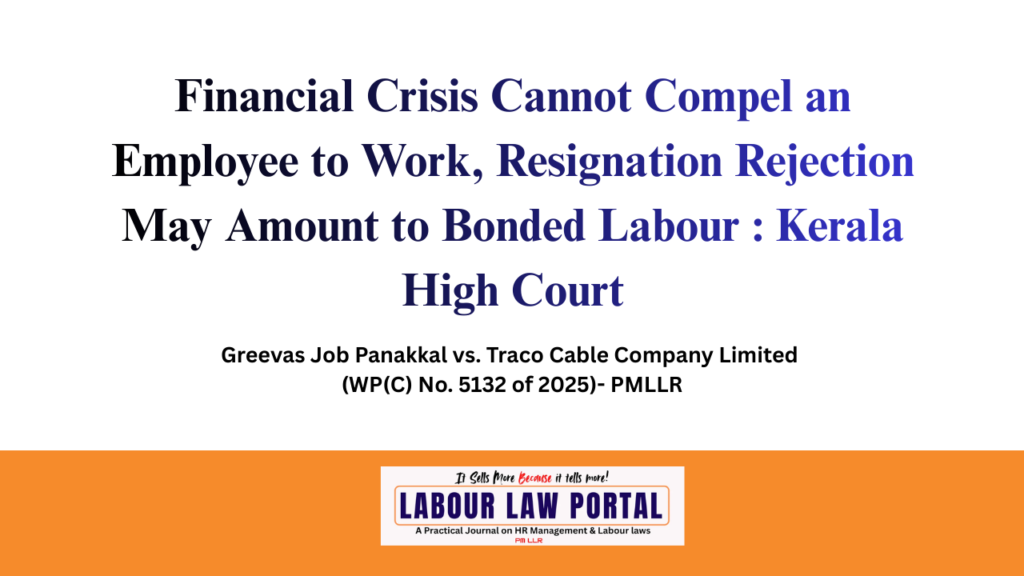
In a landmark judgment, the Kerala High Court has reaffirmed the principle that employment is a matter of free will and contractual consent, not coercion. The Division Bench, ruling in Greevas Job Panakkal vs. Traco Cable Company Limited, held that financial difficulties faced by an employer cannot justify compelling an employee to continue in service against their wishes. The Court went further to state that refusing to accept a valid resignation may amount to “bonded labour,” a practice expressly prohibited under Article 23 of the Constitution of India.
This ruling carries significant implications for labour law jurisprudence, especially in the context of public sector undertakings (PSUs) and financially distressed companies that often attempt to retain employees against their will.
The Case
The petitioner, Greevas Job Panakkal, was employed as a company secretary in Traco Cable Company Limited, a PSU. Due to pressing personal circumstances, including family health issues, he tendered his resignation. Instead of processing the resignation, the PSU rejected it, citing its precarious financial condition. The company issued show-cause notices and memos directing him to resume duty, warning of disciplinary action if he failed to comply.
The employee challenged these actions before the Kerala High Court, arguing that the refusal to accept his resignation violated his fundamental rights and amounted to forced labour.
Court’s Observations
The Division Bench made several critical observations:
- Resignation as a Right: The Court emphasised that resignation is a unilateral act of the employee, signifying their intent to withdraw from employment. Once tendered in accordance with the terms of service, it cannot be arbitrarily rejected by the employer.
- Financial Constraints Not a Defence: The employer’s financial difficulties or inability to dispense with services cannot override an employee’s fundamental right to resign. The Court categorically rejected the PSU’s argument that its financial crisis justified retaining the employee against his will.
- Bonded Labour Analogy: The Court drew a direct link between refusal to accept resignation and bonded labour. It held that compelling an employee to continue working without consent amounts to servitude, which is prohibited under Article 23 of the Constitution.
- Contractual Exceptions: The only permissible grounds for rejecting a resignation are those explicitly provided in the employment contract, such as failure to serve the notice period or pending disciplinary proceedings. Absent such contractual violations, the employer has no authority to refuse.
Judgment
The Kerala High Court directed Traco Cable Company Limited to accept the resignation and relieve the petitioner within two months. It further ordered the PSU to pay all legally due salary and benefits. The Court’s ruling underscored that forced continuance in employment due to financial constraints is unconstitutional and violates workers’ rights.
Legal Significance
This judgment is significant for several reasons:
- Reinforcement of Article 23: By equating refusal to accept resignation with bonded labour, the Court expanded the scope of Article 23 protections. Traditionally, bonded labour has been associated with exploitative practices in agriculture or manual labour. Extending this principle to white-collar employment highlights the universality of the right against forced labour.
- Employer Limitations: The ruling clarifies that employers cannot use financial distress as a shield to override employee rights. This is particularly relevant for PSUs and companies undergoing restructuring or insolvency proceedings.
- Employee Autonomy: The judgment strengthens the principle of employee autonomy in labour law. It affirms that employment is based on mutual consent, and once that consent is withdrawn, the employer cannot impose servitude.
Broader Implications
For Employees
- Employees now have judicial backing to assert their right to resign without fear of coercion.
- The ruling provides a safeguard against arbitrary disciplinary actions initiated solely to prevent resignation.
For Employers
- Employers must revisit their resignation policies to ensure compliance with constitutional principles.
- Financial distress cannot be cited as a reason to retain employees against their will.
- Companies must focus on retention through incentives and engagement, not coercion.
For Labour Law
- The judgment sets a precedent for interpreting bonded labour in modern contexts.
- It may influence future cases involving forced continuance of employment, especially in sectors facing financial instability.
Constitutional Context
Article 23 of the Constitution prohibits traffic in human beings and forced labour. Traditionally, this provision has been invoked in cases involving bonded labour in rural and unorganised sectors. By applying Article 23 to a PSU’s refusal to accept resignation, the Kerala High Court has broadened its scope, reinforcing that forced labour can take many forms, including white-collar employment.
Legal Wayout for HR
Resignation is a unilateral right: Employees can resign at will, subject only to contractual obligations like notice periods.
- Employers cannot compel continuance: Financial crisis or operational needs are not valid grounds to reject resignation.
- Bonded labour prohibition applies universally: Any form of forced employment, regardless of sector or designation, is unconstitutional.
- Policy revision needed: Organisations must align their HR policies with constitutional protections to avoid legal challenges.
Conclusion
The Kerala High Court’s ruling in Greevas Job Panakkal vs. Traco Cable Company Limited is a milestone in labour law. It reinforces the fundamental principle that employment is based on free will and mutual consent, not coercion. By equating refusal to accept resignation with bonded labour, the Court has sent a strong message that workers’ rights cannot be compromised, even in times of financial crisis.
This judgment will likely serve as a guiding precedent for future disputes involving resignation, employee autonomy, and constitutional protections against forced labour. It underscores that in India’s labour law framework, the dignity and freedom of the worker remain paramount.